
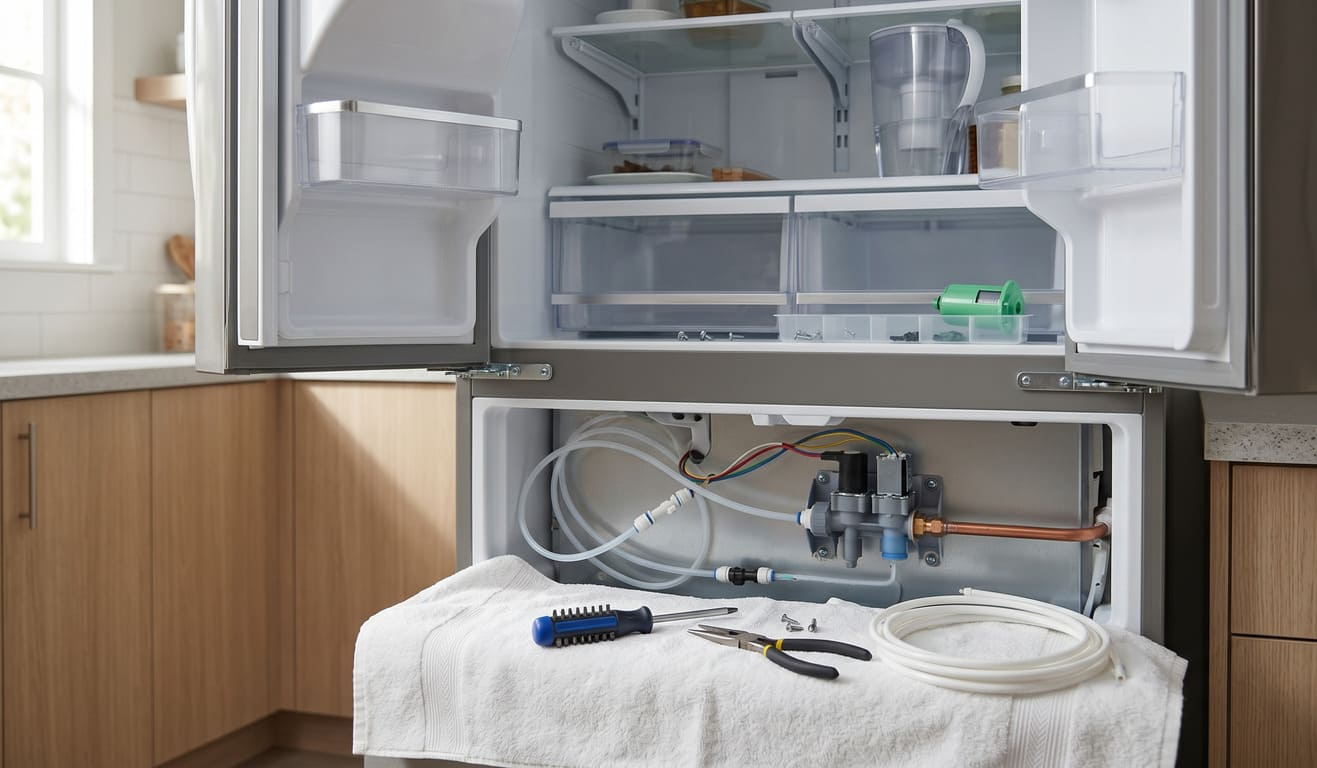
There are few things as refreshing as a cold glass of water straight from your refrigerator door. When you press your glass against the dispenser lever and nothing happens, it can be incredibly frustrating. A malfunctioning water dispenser is one of the most common complaints among homeowners, but the good news is that many of the underlying causes can be resolved with simple DIY troubleshooting.
Before you assume the worst and start looking for professional appliance repair services, there are several straightforward steps you can take to diagnose and potentially fix the issue yourself. This guide will walk you through the most frequent culprits behind a broken refrigerator water dispenser, how to test for them, and when it is finally time to call in the experts.
7 DIY Troubleshooting Steps for Your Water Dispenser
1. Check the Control Panel Lock
Modern refrigerators are equipped with digital control panels that include a “Lock” or “Child Lock” feature. This is designed to prevent children from accidentally spilling water or ice all over the kitchen floor. It is incredibly easy to accidentally activate this feature while wiping down the front of the fridge or leaning against the door.
Look at your digital display for a padlock icon or an illuminated “Lock” button. If it is active, press and hold the designated lock button (usually for three to five seconds) until the light turns off or the screen indicates the dispenser is unlocked. Test the water lever again.
2. Inspect and Replace the Water Filter
If the control panel is unlocked but water still refuses to flow, the next most likely culprit is your water filter. Refrigerator water filters are designed to catch sediment, minerals, and contaminants. Over time, these particles accumulate and can completely clog the filter membrane, restricting or entirely blocking the flow of water to the dispenser.
As a general rule, you should replace your filter every six months. If your household consumes a large amount of water or if you live in an area with hard water, you may need to replace it more frequently. Try removing the filter and installing a bypass plug (if your refrigerator came with one). If the water flows freely with the bypass plug installed, you know a clogged filter was the problem. Simply purchase and install a brand-new filter.
3. Examine the Water Supply Line
Your refrigerator gets its water from a supply line connected to your home’s plumbing. If this line becomes kinked, pinched, or disconnected, the dispenser will not work. Carefully pull your refrigerator away from the wall, being cautious not to scratch your flooring.
Inspect the plastic or braided copper tubing running from the wall valve to the back of the fridge. If you see a severe kink, gently straighten it out. If the line is damaged or leaking, it will need to be replaced. Additionally, ensure that the water shut-off valve on the wall is turned fully to the “open” position. Sometimes, these valves get bumped or partially closed during cleaning.
4. Thaw a Frozen Water Tube in the Door
The water line that runs up through the refrigerator door to the dispenser is quite narrow and is surrounded by freezing temperatures. If your freezer is set too cold, or if there is a lack of insulation in the door, this small tube can freeze solid, blocking the water flow.
- To test for a frozen line: Detach the tube at the bottom of the door hinge and blow air through it. If air does not pass through, it is frozen. Alternatively, slide a flexible zip tie up the dispenser nozzle. If it stops abruptly after a few inches, you have an ice blockage.
- To thaw the tube: Use a hairdryer set to the lowest heat setting. Keep the hairdryer moving constantly to avoid melting the plastic housing. You can also use a syringe to inject warm water up into the dispenser nozzle to slowly melt the ice block. Once cleared, ensure your freezer temperature is set between 0°F and 5°F to prevent it from happening again.
5. Test the Water Inlet Valve
The water inlet valve is an electromechanical component located at the back bottom of the refrigerator. It opens and closes to supply water to the dispenser and the ice maker. If the internal solenoids fail, or if the mineral buildup blocks the valve screen, water will not pass through.
Testing the inlet valve requires a bit more technical skill. You will need to unplug the refrigerator, access the back panel, and use a multimeter to test the valve’s solenoids for continuity. If the multimeter shows no continuity, the valve is dead and must be replaced. Because this involves electrical components and plumbing connections, many homeowners prefer to rely on a professional for this type of fridge repair to ensure it is done safely and correctly.
6. Verify Home Water Pressure
The water inlet valve requires a minimum amount of water pressure to function properly—usually at least 20 psi (pounds per square inch). If your home’s overall water pressure is too low, the valve will not open fully, resulting in a weak trickle or no water at all.
You can test this by turning off the water supply, disconnecting the supply line from the back of the fridge, and holding the end of the line over a large bucket. Turn the water back on and observe the flow. It should be a strong, steady stream. If the flow is weak, the issue lies with your home’s plumbing rather than the refrigerator itself, and you may need a plumber to investigate.
7. Check the Door Switch
Refrigerators have a small switch mounted in the door frame that detects whether the door is open or closed. For safety and efficiency, the water and ice dispenser are disabled whenever the door is open. If this door switch is broken or sticks in the “open” position, the control board will mistakenly believe the door is ajar and will refuse to dispense water.
Press the door switch in manually with your finger. You should hear a distinct click, and the interior lights should turn off. If the lights stay on, or if the switch feels loose and lacks resistance, it is likely defective and requires replacement.
Brand-Specific Considerations
While the troubleshooting steps above apply to most standard units, different manufacturers design their water delivery systems with unique quirks. When parts break, it is important to source the correct OEM replacements and rely on technicians who understand the specific brand architecture:
- Whirlpool: Often utilizes proprietary filter housings. If yours is jammed or leaking, professional Whirlpool Repair can resolve the housing issues quickly.
- LG: Known for complex, space-saving dual-dispenser setups that may require specialized LG Repair to diagnose delicate mainboard faults.
- General Electric: GE refrigerators often feature advanced smart-dispense systems. Expert General Electric Repair ensures these sensors are calibrated correctly.
- Dacor: High-end and built-in luxury units demand delicate handling. Trusting dedicated Dacor Repair protects your premium appliance investment.
- Beyond the Kitchen: Reliable service companies don’t just stop at refrigerators. If you are also experiencing laundry issues, these same expert technicians provide top-tier Speed Queen Repair to keep your entire home running smoothly.
When to Seek Professional Assistance
While checking a filter or thawing a line is simple, dealing with complex wiring, control boards, or sealed system components can be dangerous. If you have exhausted the basic DIY steps and your dispenser is still completely unresponsive, it is time to call in the experts.
If you are a resident in the Pacific Northwest, local, fast, and reliable help is readily available. Homeowners can count on premium APPLIANCE REPAIR IN SEATTLE to effectively diagnose stubborn control board failures or valve replacements. Alternatively, if you are located across the lake, you can schedule prompt Bellevue Appliance Repair Services to ensure your kitchen is back up and running without delay.
Professionals have the diagnostic tools needed to test the main control board and dispenser microswitches accurately. Furthermore, if you are running a business and dealing with a faulty industrial unit, do not attempt to fix complex internal mechanisms yourself. Seek specialized commercial refrigerator repair to ensure health codes are maintained and your equipment warranty is not voided. Professional technicians handle everything from minor fridge repairs to total system overhauls, saving you time and preventing further damage to your appliance.
Troubleshooting Summary Table
| Symptom | Possible Cause | Recommended Solution |
| No water, no sound from dispenser | Control panel is locked | Press and hold the “Lock” button for 3-5 seconds to unlock. |
| Water trickles slowly | Clogged water filter | Replace the water filter with a new one. |
| Dispenser hums but no water flows | Frozen water tube in door | Use a hairdryer on low heat or warm water syringe to thaw the line. |
| No water, interior lights stay on | Defective door switch | Test switch manually; replace if it fails to turn off interior lights. |
| No water, strong water pressure | Faulty water inlet valve | Test solenoids with a multimeter; replace valve if it lacks continuity. |
Frequently Asked Questions (FAQ)
1. Why is my water dispenser making a clicking noise but no water comes out?
A clicking noise usually comes from the water inlet valve attempting to open. If you hear the click but get no water, the valve might be receiving power but is mechanically stuck due to mineral buildup, or the water line leading to the valve is kinked or frozen.
2. How often should I replace my refrigerator water filter?
Manufacturers generally recommend replacing the water filter every six months. However, if your home has hard water, or if you notice a decrease in water flow or a change in the taste of the water, you should replace it sooner.
3. Can a bad water filter cause the dispenser to stop completely?
Yes. If a filter is left in the refrigerator long past its lifespan, the internal carbon mesh can become so heavily saturated with debris, minerals, and sediment that it acts as a physical barrier, completely stopping the flow of water to your glass.
4. Why is my fridge dispensing water very slowly?
A slow flow is most commonly caused by a partially clogged water filter or low household water pressure. Check your filter first. If a new filter does not solve the issue, you may need to check the supply valve behind the fridge to ensure it is fully open, or test your home’s water pressure to ensure it meets the 20 psi minimum requirement.
5. Is it safe to thaw a frozen water line with a hairdryer?
Yes, but you must be extremely careful. You should only use the hairdryer on its lowest heat setting and keep it moving back and forth continuously. Holding direct, high heat in one spot can easily warp or melt the plastic interior lining of your refrigerator door, causing permanent and costly damage
Trusted Professional Repair Services and Supported Brands
When DIY troubleshooting isn’t enough to get your refrigerator’s water dispenser flowing again, it is essential to rely on certified professionals. Modern appliances feature highly complex digital boards, sealed cooling systems, and intricate plumbing that require specialized knowledge. Our expert technicians are extensively trained to handle a wide variety of top household appliance brands.
Whether you need delicate Dacor Repair for high-end luxury built-in units, advanced diagnostics for General Electric Repair, or prompt LG Repair for complex smart refrigerators, we have the tools and expertise to fix it right the first time. We also provide trusted Whirlpool Repair for standard kitchen configurations, and our expertise extends beyond the kitchen to include reliable Speed Queen Repair to keep your laundry room operating at peak performance