
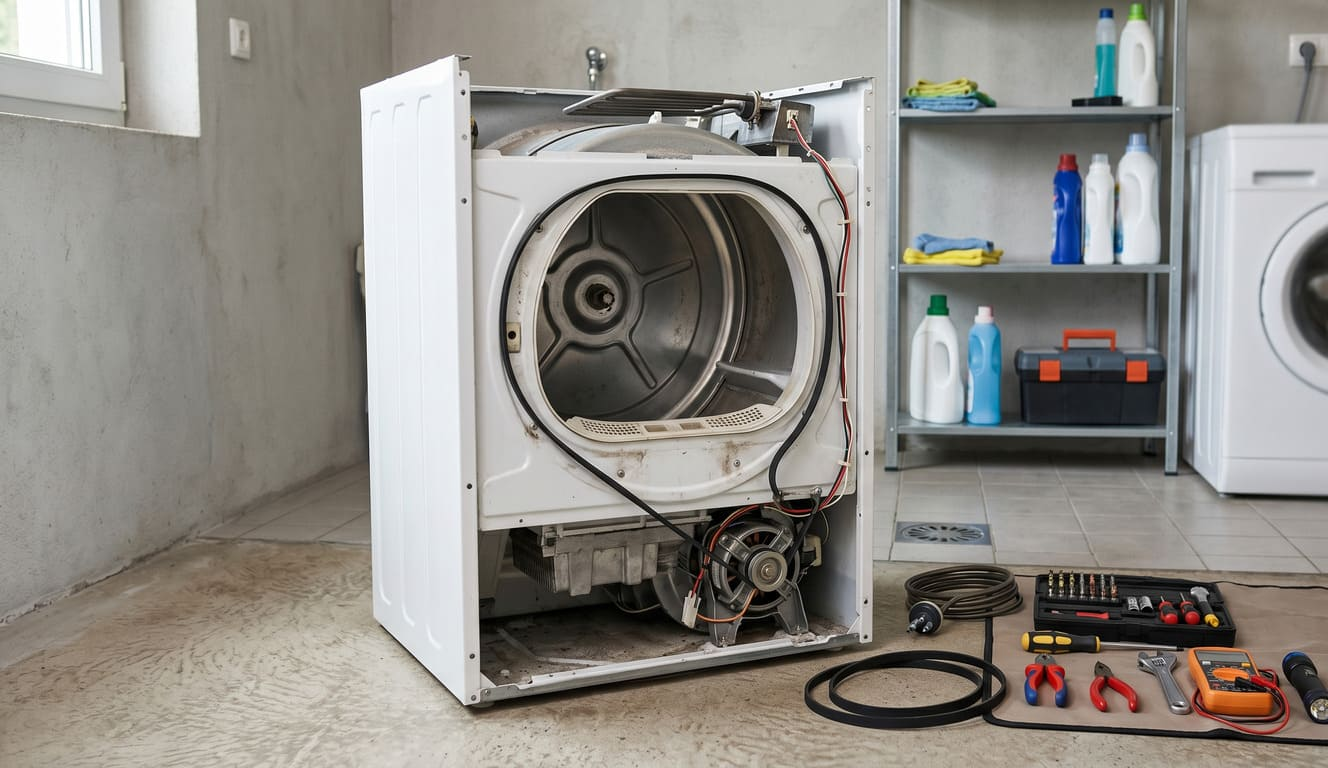
Few things disrupt the rhythm of a household quite like a laundry room failure. You pull a load of wet clothes out of the washing machine, toss them into the dryer, press the start button, and nothing happens. Or worse, the machine starts up but emits a terrifying grinding noise, or runs for an hour only to leave your clothes just as damp as when they went in. When your dryer stops functioning correctly, you are immediately faced with a stressful and potentially expensive dilemma: do you attempt to fix the machine, or is it time to head to the appliance store for a brand-new model?
Making the right choice requires balancing immediate upfront costs, long-term energy efficiency, and the overall expected lifespan of your current machine. While throwing in the towel and buying a new unit might seem like the easiest path, it is not always the smartest financial decision.
The 50% Rule and Appliance Lifespans
When evaluating major appliance repairs, industry professionals frequently rely on what is known as the “50% rule.” This simple but highly effective guideline states that if a repair costs more than 50% of the price of a new, comparable model, and your current machine is more than halfway through its expected lifespan, replacement is the more financially sound decision.
To apply this rule, you first need to know how long a dryer is actually supposed to last. On average, a standard electric or gas dryer boasts a lifespan of about 10 to 13 years with regular use and basic maintenance (like cleaning the lint trap after every load and clearing the main vent line annually).
If your unit is pushing past the 10-year mark and experiences a major failure, investing heavily in replacing a motor or a computerized control board is often a losing battle. At that age, internal components are degrading across the board, and fixing one specific part might just be an expensive stopgap before another critical component fails a few months later. Conversely, if your machine is only three, four, or five years old, opting for appliance repair is almost always the more logical and cost-effective route, as the unit still has many years of viable life left ahead of it.
Diagnosing Common Problems and Costs
Understanding what might be wrong with your machine is a crucial step before you pull the plug on your old unit. Some issues are incredibly cheap and straightforward to resolve, while others require significant labor and highly expensive replacement parts.
If your dryer runs perfectly fine but does not produce any heat, you are likely dealing with a blown thermal fuse, a broken heating element (in electric models), or a faulty gas valve igniter (in gas models). These are incredibly common, routine issues. An appliance repair service can usually resolve these problems quickly and affordably, often for under a couple of hundred dollars. Replacing a snapped drive belt—which typically causes the drum to stop turning completely despite the motor running—is another relatively inexpensive fix that can breathe new life into an otherwise perfectly healthy machine.
However, the math changes when you are dealing with catastrophic failures. If the main electronic control board has shorted out due to a power surge, or if the primary drive motor has seized and burned out, you are looking at substantial part costs combined with significant labor fees. In these instances, especially on units older than seven or eight years, the financial scale tips heavily toward replacement.
Brand-Specific Considerations
The brand of your appliance also significantly influences the repair versus replacement equation. Premium and luxury brands often have higher upfront replacement costs, making repairs much more viable even later in the machine’s life cycle. For instance, investing in professional Miele Repair or Thermador Repair is almost always recommended before considering a costly replacement, as these high-end machines are built with superior engineering designed for longevity. Similarly, robust, professional-grade units might require specialized expertise, making Bluestar Repair a smart investment to protect the value of your appliance.
On the other hand, more widely accessible brands are excellent candidates for cost-effective fixes. Standard Frigidaire Repair or routine Kenmore Repair can often be completed quickly since parts are readily available and highly affordable. Knowing the pedigree of your machine helps accurately gauge whether a repair is a long-term investment or a temporary stopgap.
Energy Efficiency Considerations
When weighing your options, you must look beyond the immediate price tag of the repair bill versus the retail price of a new unit. Energy efficiency plays a massive role in the long-term cost of operating any laundry equipment. Older models, particularly those built more than a decade ago, consume significantly more electricity or natural gas than modern, optimized units.
Upgrading to a newer, Energy Star-certified model—such as a highly efficient heat pump dryer—can noticeably reduce your monthly utility bills. Heat pump dryers, for instance, recycle the hot air inside the drum rather than venting it outside, using up to 50% less energy than conventional electric dryers. Over the course of a few years, these monthly utility savings can help offset the initial purchase price of a new machine. If your current dryer is an energy hog, replacing it might actually save you money in the long run, even if a clothes dryer repair was technically possible.
The Hidden Costs of Replacement
It is easy to look at a holiday sale flyer, see a new dryer listed for $500, and assume that is your total out-of-pocket cost. Unfortunately, purchasing a new dryer comes with several hidden costs that frequently catch homeowners completely off guard.
When budgeting for a new machine, you must account for delivery fees, installation charges, and haul-away fees for disposing of your old unit. Furthermore, new dryers almost never come with the necessary hookup accessories in the box. You will likely need to purchase a new power cord (as home wiring codes dictate whether you need a 3-prong or 4-prong plug), a new semi-rigid venting hose, and, if you are buying a gas dryer, a new flexible gas line. When you add all of these supplementary expenses up, a “cheap” new dryer might actually cost you $150 to $250 more than the retail sticker price suggests. Suddenly, that $200 dryer repair looks much more appealing and financially manageable.
Environmental Impact and Sustainability
In today’s world, the environmental impact of our consumer choices cannot be ignored. Discarding a large household appliance contributes significantly to landfill waste, even if the metal chassis is eventually recycled. The process of manufacturing, packaging, and shipping a brand-new dryer from overseas facilities also carries a massive carbon footprint.
Opting to fix your existing machine is a highly sustainable and eco-friendly choice. By repairing what you already own, you actively extend the life cycle of manufactured goods and reduce the growing global problem of electronic waste. If a qualified technician can get your unit running safely and efficiently for a few more years, keeping it out of the landfill is an excellent decision for the environment.
Repair vs. Replace: A Quick Comparison
To help clarify your decision, use this breakdown of the pros and cons of both options:
| Factor | Repairing Your Old Dryer | Buying a New Dryer |
| Upfront Cost | Usually much lower; pay only for parts and labor. | High initial investment plus hidden installation fees. |
| Time Investment | Varies; requires scheduling a technician and waiting for parts. | Can often be purchased and delivered within a few days. |
| Lifespan | Adds a few years to an older machine; highly effective for young units. | Resets the clock with a brand-new 10 to 13-year lifespan. |
| Energy Efficiency | Remains exactly the same as before it broke down. | Often yields immediate utility savings with modern technology. |
| Environmental Impact | Highly sustainable; keeps large metal waste out of landfills. | High carbon footprint from manufacturing, shipping, and disposal. |
| Warranty | Short warranty on the specific replaced part (usually 30-90 days). | Full manufacturer warranty covering the whole machine (1-3 years). |
Making the Final Call
Ultimately, the decision rests on a combination of your household budget, your machine’s age, and your tolerance for disruption. Check to see if your broken unit is still under a manufacturer’s warranty or an extended home warranty plan before doing anything else, as this will make your decision infinitely easier.
If you decide to pursue the repair route, it is vital to hire a reputable professional. While cleaning a lint trap or swapping out a basic belt might be a weekend DIY project for a handy homeowner, attempting complex fixes involving high-voltage electrical components or volatile natural gas lines is extremely dangerous.
When searching for a qualified technician, localized service guarantees faster turnaround times and accountability. For homeowners in the Pacific Northwest, relying on top-rated Bellevue Appliance Repair Services or scheduling prompt APPLIANCE REPAIR IN SEATTLE ensures that your dryer is handled by licensed experts who can pinpoint the exact issue immediately. This targeted expertise ensures you don’t waste time and money throwing random parts at a problem you haven’t properly identified.
Frequently Asked Questions
1. How do I know if my dryer is worth fixing?
Apply the 50% rule: if the repair estimate is more than half the cost of a comparable new dryer and your machine is over six or seven years old, it is usually better to replace it. If the repair is cheap or the machine is relatively new, repairing it is the smarter choice.
2. What is the most expensive part to replace on a dryer?
The main electronic control board and the drive motor are typically the most expensive components. When these parts fail—especially the motor—the combined cost of the component and the labor required to install it can easily exceed $300 to $400.
3. How long should a standard clothes dryer last?
With proper maintenance, a standard gas or electric dryer should last between 10 and 13 years. Routine maintenance, such as deep-cleaning the exhaust vent annually, drastically reduces strain on the motor and heating elements, helping the machine reach its maximum lifespan.
4. Can I safely fix my broken dryer myself?
Minor maintenance like replacing a thermal fuse or a broken door switch can be done by a handy homeowner. However, any repairs involving the 240-volt electrical block, computer boards, or the gas valve assembly should be left to a trained professional due to the severe risks of fire, electrocution, or gas leaks.
5. Will buying a new dryer actually save me money on my electric bill?
It depends on what you are upgrading to. Upgrading from a 15-year-old electric dryer to a modern, standard vented model will yield minor savings. However, upgrading to a highly efficient Heat Pump dryer can cut your drying energy usage by up to 50%, resulting in noticeable long-term savings on your utility bills